Going Back to Work and Handing Over the Feeding
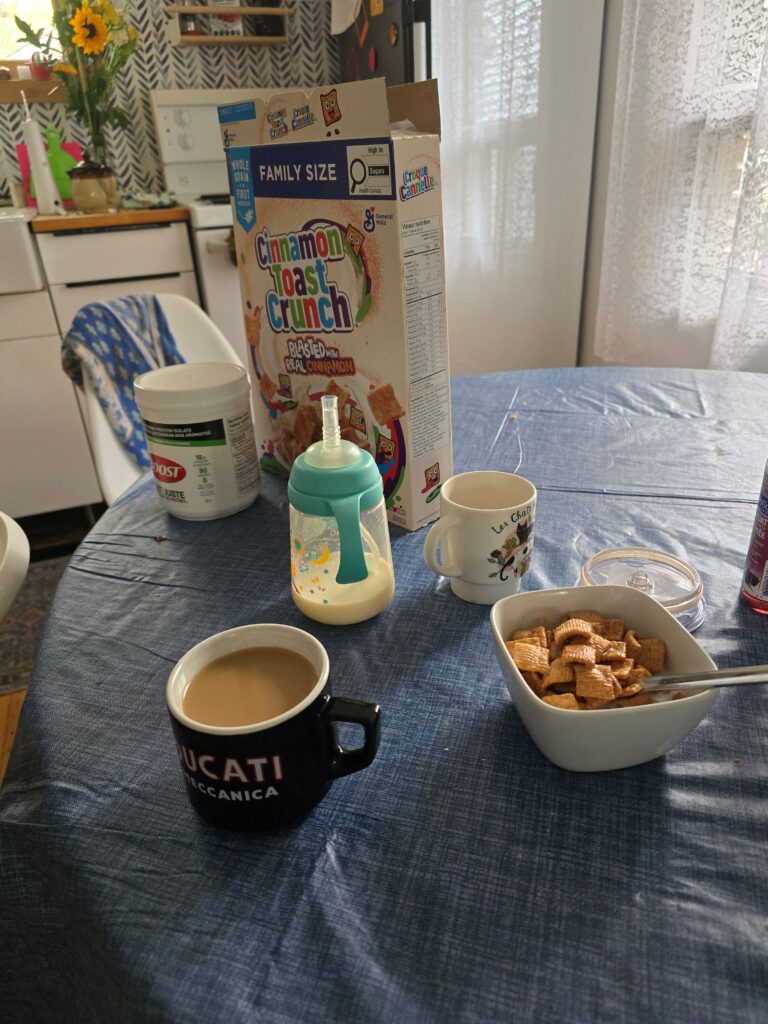
The return date is decided before your little person even arrives, often. In Quebec the parental benefits have to wrap up within 78 weeks of the birth, and most of the families I work with land somewhere between nine months and a year and a half, often in the same week as the first day at the garderie, so the week that was supposed to be about getting back into work clothes and finding the badge turns into a week of standing in the kitchen at six in the morning trying to get a ten-month-old to take a bottle they have taken exactly twice in their life.
The bottle at ten months
The baby clamps down, turns their head, cries, and the partner or the grandparent holding the bottle gives up after twenty minutes and hands them back, and with a return date three weeks out, the whole thing starts to feel like something that has to be solved by Friday.
Do remember: a baby at ten months is eating three meals of actual food, pulling themselves up on the coffee table and grabbing whatever cup is within reach, and the Canadian Paediatric Society’s feeding handout mentions a cup right alongside a bottle for expressed milk. In the toddler rooms at most of the daycares my clients use, the educators hand out small open cups at snack and nobody expects a bottle at all. The more useful question by then is how much milk they need during the hours away, and whether a cup at lunch and a feed at pickup covers it. For a lot of babies at that age it does, and the bottle goes back in the cupboard with the pacifiers they also stopped taking. Straw cups, sippy cups, those genius 360 numbers, that’s where it’s at sometimes when the bottle isn’t the vibe.
What happens to supply across eight hours
One nursing parent pumps once at lunch for the first month back and then drops it, another pumps twice a day for as long as they are nursing and would not have it any other way, and a third stops pumping at work entirely and finds the morning feed and the evening feed carry on for months afterward. The first couple of days back usually involve a very full and uncomfortable afternoon, and a pump or a hand expression break in the washroom at two o’clock is often about comfort as much as milk. If the plan is to keep things going mostly as they were, it helps to start pumping a couple of weeks before the return date, one session a day after a morning feed, so there is some milk in the freezer and the pump is not a stranger on the first Monday.
Pumping at work, in Quebec specifically
Provincial labour standards do not set out pumping breaks, and what happens in a Quebec workplace comes down to what the employer agrees to, as Nourri-Source’s return-to-work guide puts it. The same guide points out that breastfeeding itself is protected under the Quebec Charter, so no one can tell you to stop nursing your baby in the building if the baby is brought to you, but a room with a door that locks and twenty minutes twice a day is a request, not an entitlement. (Which, ugh).
The request tends to go better when it is specific (how many sessions, how long each one runs, where the milk goes afterward, and a room that is not a washroom). A systematic review of employer programs across ten countries found that a lactation space and scheduled breaks were each linked to better breastfeeding outcomes in most of the studies that looked at them. (Which, duh).
What to hand the educator
Most daycares will provide formula and cows’ milk. Many people I have spoken to were like, “okay but will they take my breast milk?”
Good daycares, absolutely. If they have a preference for delivery method, honour it: mine took jars, frozen bags, unfrozen bags (milk-specific bags, please, not ziplocs – they leak. Trust me, they leak.) Label it well (“Baby C, Date delivered: 2026-10-07, use by 10/10”). Most will report back how much milk they took; some will send home leftovers; some will toss it.