Bleeding After You Start Moving Again
Bleeding that turns red again after the first long walk at five weeks, or spotting after the first run at four months, and the Quebec thresholds for when to call someone.
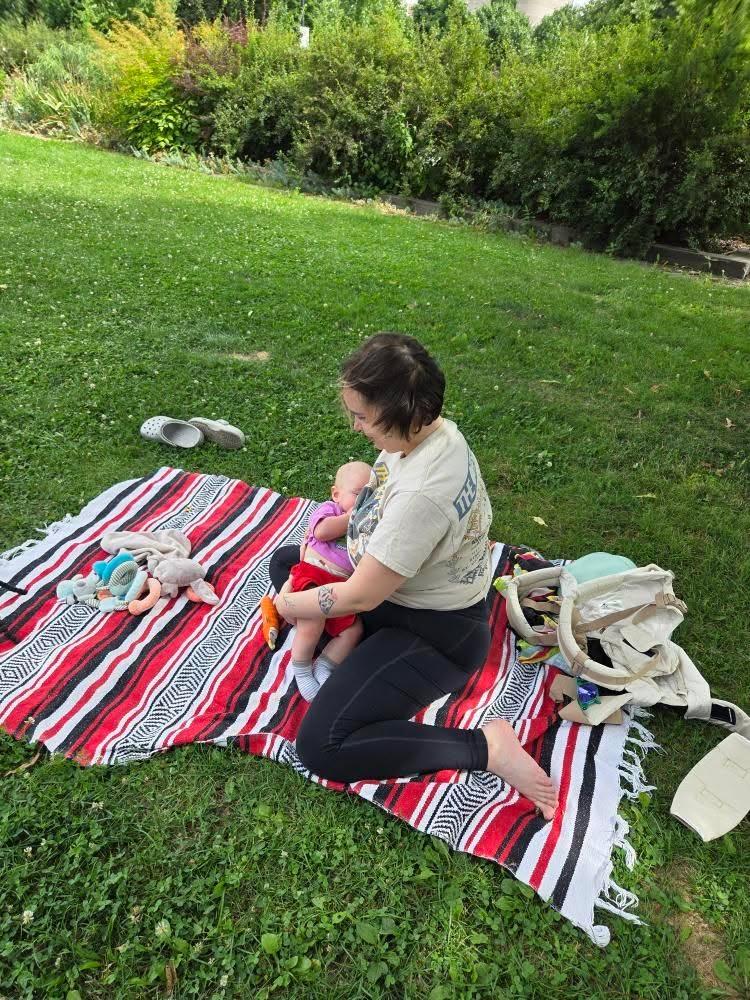
The message tends to come in around five weeks, sometimes a little later, from someone who had finally got the bleeding down to a brownish smear on the pad and then went for a proper walk, the long loop to the park and back with the stroller instead of once around the block, or carried the car seat up three flights because nobody else was home, and found it bright red again by the evening. They want to know whether they tore something. The other version comes at four or five or six months, after the first class back at the gym or the first slow run along the canal, and it’s the same question with more embarrassment folded into it, because by then the people around them have mostly stopped asking how the body is doing.
Bleeding after birth (lochia) lasts three to six weeks for most people, according to Mieux vivre avec notre enfant, the free guide most Quebec families are given during the pregnancy. The same page describes the colour moving from pink to brown to a pale yellow, and mentions in passing that unusual effort can bring back bleeding that is redder and heavier for a while. Very few of the parents I work with remember reading that sentence, which sits in a section most of them got through quickly somewhere in the third trimester.
The real timelines are also longer and less tidy than three to six weeks. A WHO study that followed just over four thousand breastfeeding parents in seven countries found a median of 27 days of lochia, with about one in nine still bleeding past day 40, and roughly a fifth having a separate bleeding episode right around the 40th day, after things had seemed to stop. That lands in the same week a lot of people start doing more, and the same week as the six-week appointment, so the walk and the blood get read as cause and effect even though the same bleed shows up in plenty of people who spent that week on the couch. A 2012 systematic review of eighteen studies on lochia found average durations anywhere from 24 to 36 days, and only one of those studies had kept track until the bleeding actually ended.
The six-week visit is where many people hear the word “cleared,” and it covers a lot in a short time, often the stitches or the incision, blood pressure, contraception and a few questions about mood and sleep. What it rarely includes is anyone watching you lift a car seat or squat to the bottom drawer, or an internal check of the pelvic floor, so the clearance people walk out with is mostly clearance for ordinary life.
The return to moving that seems to go best, from what I’ve watched, is slow and a bit boring, and the bleeding itself is useful along the way. Walking first, then longer walks, then the hill with the stroller, then carrying the laundry basket and the car seat, a few days at each step, with running and jumping and the class with the burpees left for later, ideally after someone has looked at the pelvic floor. When a longer walk brings the red back, that tells you something about that day, and for most people it settles within a day or so of going back to the shorter walk. If it keeps happening at the same level of effort, or comes with heaviness or a dragging feeling low in the pelvis, or with leaking, a pelvic floor physiotherapist can assess how the pelvic floor and the abdominal wall are managing and build a progression around the person in front of them. There is a longer piece on who does that assessment in Montreal and what it costs.
By four or six months, bleeding after a workout is more often a period or the beginning of one. Periods come back on very different schedules, often sooner for people who are formula feeding or who have dropped the night feeds, and the first few can be irregular, or heavier than before, or show up as spotting after a hard day (there’s more on that in the first period). Cramping after exercise at that stage comes up on the forums a lot as well, and it’s a reasonable thing to bring to the next appointment. Less often, bleeding that comes back heavier weeks after the birth can mean a piece of placenta or membrane stayed behind.
When to call someone
The Mieux vivre guide is specific about when bleeding needs a doctor or midwife quickly, or the emergency room: a regular pad soaked through every hour for two hours in a row, more than one clot the size of an egg, a fever of 38.0°C or higher, or belly pain that painkillers don’t touch. Bleeding that increases over several days instead of tapering is a reason to call whoever followed the pregnancy. Weakness, paleness, cold and clammy skin, sweating, confusion or a racing heart along with the bleeding are signs of shock, and that’s 911. Clots on their own, especially first thing in the morning or after peeing or a feed, are common and not a concern if the bleeding eases once they pass.
For the in-between cases, the red that came back after the long walk or the spotting after the first run, 811 option 1 reaches an Info-Santé nurse at any hour, every day of the year, in French or English, and the nurse can say whether it can wait for the next appointment or needs to be seen sooner.